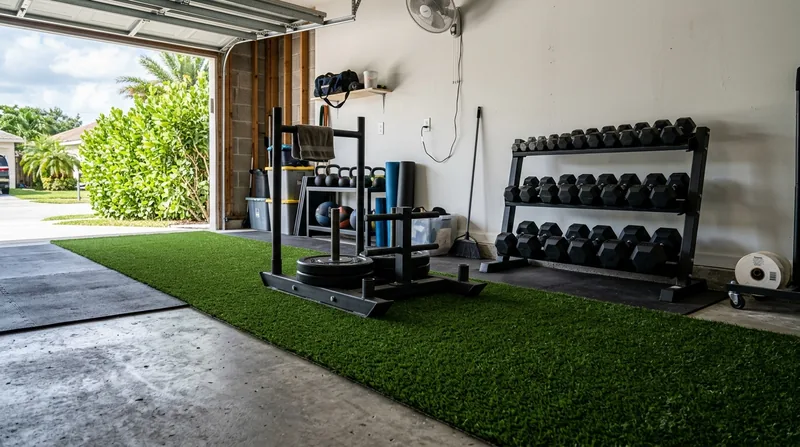




Sports, Gym & Court Turf in Miami demands turf engineered for high foot traffic, fast drainage, and the relentless heat and humidity of South Florida. Whether you're installing a batting cage, a CrossFit box, a home gym court, or an athletic field, synthetic turf built for performance handles the pounding that natural grass cannot. Miami's flat terrain, porous limestone base, and year-round heat make artificial turf a practical choice for facilities that operate daily under intense use. We install competition-grade and recreational turf with the right face weight, pile height, and infill to match your sport, your traffic level, and your budget. Since 2013, we've built courts and training surfaces across Miami, Coral Gables, Kendall, Doral, and surrounding areas, using turf specs that are written down and transparent. Let's talk about what your facility needs.
Why Sports and Gym Turf Matters in Miami's Heat and Humidity
Natural grass fails under constant foot traffic and Miami's summer heat. Real sod burns out in shade, thins from chinch bugs, and dies under the intensity of daily athletic use. Synthetic turf stays playable in 95-degree heat, drains standing water from summer thunderstorms, and requires no fertilizer, fungicide, or weekly mowing. A gym court or batting cage built on bare dirt turns to mud in the rainy season and dust in the dry season. Proper artificial turf installation on a compacted base with drainage layer handles Miami's climate and protects your investment for years.
- We select turf with face weight and pile height rated for your sport to ensure durability under repetitive impact.
- Drainage underlayment moves water away from the turf and down through the base, preventing pooling in low spots.
- Infill (rubber, sand, or hybrid) provides cushioning, traction, and heat management for athlete safety.
- Seaming and edge restraint are done to specification so the turf stays flat and secure through seasons of use.
- We write the turf spec, infill type, and base depth on paper so you know exactly what was installed.
The result is a court or training space that stays playable year-round, even during Miami's intense summer downpours and oppressive heat.
Key info: Miami's summer thunderstorms drop 2 to 3 inches of rain in an hour. Without proper base prep and drainage, a court built on bare dirt becomes unusable. We size the drainage layer and compact the base to move that water off the playing surface and away from the facility.
For detailed guidance on how artificial turf compares to natural grass and other surfaces, see our full comparison guide on the homepage.
For more information on turf regulations and best practices in Florida, visit the City of Miami Beach Planning and Zoning Department.
How We Install Sports, Gym & Court Turf: Step by Step
A court or gym turf installation starts with a site walk and honest assessment of drainage and soil. We mark utilities with Florida 811 locates, remove any existing surface, grade and compact the base, lay a drainage layer, position the turf, seam it, and secure the edges. The whole process takes 3 to 7 days depending on size and site conditions. We measure everything, write the specs, and stand behind the workmanship.
- We visit the site to evaluate drainage, soil condition, and any slopes or low spots that need correction.
- We request utility locates and identify irrigation lines, electrical runs, and any underground obstacles.
- We remove the old surface and grade the base to proper elevation and slope for water runoff.
- We compact the base with a plate compactor to 95% density so the turf sits on solid ground.
- We lay a geotextile fabric and drainage layer to move water away from the turf and into the subsurface.
- We unroll and position the turf, seam it with adhesive and backing tape, and secure the edges with landscape stakes or perimeter restraint.
- We install infill (rubber, sand, or hybrid blend) and brush or rake it into the pile to lock it in place.
- We perform a final walkover to confirm seams are tight, edges are secure, and the surface is ready for play.
Every step is documented and the finished turf meets the specifications we committed to in writing.
Local example: A 2,000 sq ft batting cage in Kendall required removal of old cracked asphalt, base grading to handle the summer water table, a 4-inch compacted limestone base, geotextile and drainage layer, and 60-ounce face weight turf with rubber infill. The job took 5 days and the facility opened for play 48 hours after we finished. That's the standard we hold.
For repair work on existing turf, see our turf repair and seam repair service.
Sports, Gym & Court Turf Installation Methods
| Approach | Description | Best for |
|---|---|---|
| Compacted Base with Drainage Layer | Limestone or recycled asphalt base compacted to 95% density, geotextile fabric, and perforated drainage layer underneath turf. | All sports and gym courts, especially in Miami where water management is critical. |
| Rubber Infill System | Recycled rubber granules raked into the turf pile to provide cushioning, traction, and temperature regulation. | High-impact sports (basketball, volleyball, CrossFit), batting cages, and facilities where athlete safety is the priority. |
| Sand or Hybrid Infill | Silica sand alone or blended with rubber for a firmer, cooler playing surface with less maintenance. | Tennis courts, field sports, and facilities where a faster, lower-bounce surface is preferred. |
| Seaming and Edge Restraint | Adhesive and backing tape seams with landscape stakes or aluminum perimeter restraint to lock the turf in place. | All installations; critical for high-traffic areas and facilities that operate year-round in Miami heat. |
Sports, Gym & Court Turf Cost in Miami: What to Expect
Sports and gym turf costs starting at $8 per square foot for a basic installation with standard infill and a 4-inch compacted base. A 2,000 sq ft court runs roughly $16,000 to $22,000 depending on site prep, drainage needs, infill type, and turf face weight. Larger facilities or complex sites with grading, utilities work, or reinforced base layers cost more. The price includes removal of old surface, base prep, drainage layer, turf, seaming, infill, and labor.
Factors that move the price:
- Site prep and grading: sloped or uneven terrain requires more base work and compaction.
- Existing surface removal: asphalt, concrete, or old turf adds labor and disposal cost.
- Turf face weight and pile height: higher-spec turf rated for intense impact costs more than recreational-grade.
- Infill type: rubber infill is more expensive than sand, hybrid blends fall in the middle.
- Drainage complexity: sites with poor drainage or high water table need thicker or reinforced base layers.
- Facility size: smaller courts (under 1,000 sq ft) have higher per-square-foot cost because seaming and edge work don't scale down.
We measure your site and provide a detailed written estimate that breaks down turf cost, infill, base, and labor so you see exactly what you're paying for. For a full pricing overview and worked examples, visit our pricing page.
Sports, Gym & Court Turf Near Me: What to Look for When Hiring a Turf Installation Company
Not every turf installer understands sports and gym surfaces. Many crews lay 40-ounce turf on bare dirt, skip proper drainage, and leave you with a surface that fails in Miami's heat and rain. When hiring a turf installation company in Miami, Coral Gables, Kendall, or any neighborhood, check these things: Does the company provide a written specification naming the turf product, face weight, pile height, infill type and pounds per square foot, and base depth? Do they carry a certificate of insurance naming general liability and workers' compensation? Can they show photos and references from similar sports or gym projects? Do they explain how they'll handle Miami's drainage challenges and summer storms? Are they local, with a Miami address and phone number you can reach?
- Ask for a written spec that names the turf brand, face weight, pile height, infill type, infill density, and base depth and compaction standard.
- Request a certificate of insurance showing general liability and workers' compensation coverage before work starts.
- Review photos and references from at least two completed sports or gym turf projects of similar size.
- Confirm they understand Miami's summer rain, water table, and heat, and ask how they'll design drainage for your site.
- Get multiple estimates and compare what each one includes; the cheapest price often means skipped steps.
- Verify they can handle any HOA or facility management approval requirements specific to your location.
A strong turf installer explains their process, stands behind their work in writing, and is reachable by phone. We're fully insured and we put every job on paper. Contact us for a free estimate.
Sports, Gym & Court Turf in Miami: Pricing Guide
| Service | Price | Details |
|---|---|---|
| Standard Sports & Gym Court Turf | Starting at $8/sq ft | Includes compacted 4-inch base, drainage layer, turf, seaming, and standard infill with labor and removal |
| High-Performance Batting Cage or Impact Sport Turf | Starting at $10/sq ft | Premium face weight turf rated for heavy impact, reinforced rubber infill, and enhanced base compaction for durability |
| Complex Site with Grading or Poor Drainage | On estimate | Sites requiring significant grading, deep base layers, or water management solutions need on-site assessment before pricing |
| Travel and Site Visit | Included | No mileage fee or travel charge for estimates and installations within Miami and surrounding service areas |
| Free Estimate | No charge | Response within 24 hours at (786) 744-5371, includes site walk, drainage assessment, and written quote with no obligation |
Indicative pricing, the exact cost depends on square footage, finish, and site access. Free personalized estimate within 24h at (786) 744-5371.


